Wednesday, March 19, 2014

outling is a reading skill too!

Advanced Composers,

Today in class seemed to confuse a few of you, so I wanted to provide a bit of clarification in this blog post.  First of all, the homework to complete tonight is a reading task not a writing one.  You are to outline your "expertise book" author's "opening matter" -- that is the Introduction, Preface, Preamble, or Forward.

This outline is the "skeleton" of the author's argument, and our various authors will include these bits of "opening matter" in an effort to lay out the much, much longer work's cogent features and arguments.  In essence, the "opening matter" in book-form non-fiction is a "road map" for the rest of the text, and, reading the "opening matter" along with the Table of Contents will provide a complete picture of the depth of the longer work's full revelations and insights.

I've found a relevant post from Salisbury University (in Maryland), and I will re-post the best bit here:


"The key to both outlining and summarizing is being able to distinguish between the main ideas and the supporting ideas and examples. The main ideas form the backbone, the strand that holds the various parts and pieces of the text together. Outlining the main ideas helps you to discover this structure ..."

So, you are outlining the main points (essentially listing the main points in an organized, tiered fashion).  Your own outline will look nothing (really) like mine, as no one of you is reading To End All Wars.  (I also sent you via email a handwritten, .pdf copy of the Google Doc that is linked in the previous sentence.)

Wednesday, March 12, 2014

rhetorical analysis resources -- all in one place!

Advanced Composers,

I want to remind you of all of the resources at your disposal for writing the Rhetorical Analysis.  I would review them in this order:


Also, I have done a bit of internet searching on your behalf, and I have three good college writing center pages to share.  (The college writing center information is particularly rich in general and the various approaches to writing this type of assignment are often pointed and highly relevant.)

Try these three:

Thursday, February 13, 2014

you are blogging now!

Students,

Yesterday and today in class you will be working on your new blog -- you are an author now! I put together this short presentation to assist you in setting up your account properly and getting started with a few initial edits.  Write about anything (and the assignments I will give you). Most of all - have fun!

Tuesday, October 15, 2013

Adv. Comp: Background on Blogging for Purposes of Writing Your Own Posts Part 2

So ... it is easy (to some extent) then to see just how influential and important the weblog or "blog" is in our contemporary internet-based, media culture.  But, who are some influential bloggers and/or influential blogs?  I have my own opinions, and I would like you to form some of your own too ...

Without a doubt Andrew Sullivan (The Dish) is one of the country's most influential bloggers, and, in fact, Harvard Magazine named him the "world's most influential blogger."  Sullivan, born in the UK but now living in the US is a devout Catholic, despite the fact that he is openly gay.  Sullivan has done a great deal to advance awareness of issues around sexual identity even though his political stances are conservative of a libertarian-cum-republican order.  He is a blogger to know.

Nicholas Carr and Mark Blumenthal are two additional bloggers to know from the political-cultural commentary world.  Carr, who blogs at Rough Type (great name btw!), has recently raised significant questions around our insatiable internet dependence, most notably in an excellent article for The Atlantic Monthly, entitled "Is Google Making Us Stupid?"  Subsequent to his article, Carr wrote a book regarding the same topic.

Other important bloggers and/or blogs include Jenny Lawson, a former Houston Chronicle reporter who blogs as "The Bloggess" (great handle, huh?), scienceisbeauty (which may single-handedly prove not all of tumblr is total trash), and James Fallows, a nationally renowned correspondent for The Atlantic Monthly.

Some important multi-author-blogs or MABs include Talking Points Memo (TPI), the Ted Blog, and The Huffington Post.

Monday, October 14, 2013

Adv. Comp: Trimming Your Memory Narrative into an App Essay

Now that we are post-Columbus Day, it is time to form that MN into a college app. essay (for those of you who need one).  First, please complete this survey, so I know who needs to do what -- this will help me help you!

Then, if you need assistance with trimming, follow this link to a presentation I've created to assist you.  Work through these slides, and you should be able to edit down and polish to an acceptable app. essay!

Keep in mind that this process is "on your own time" as we are moving to new challenges in class ... 

Wednesday, October 9, 2013

Adv. Comp.: Background on Blogging for Purposes of Writing Your Own Posts Part 1

During the course of the semester, I will ask you to add entries to your "Research Blog" -- the first entry regarding your Editorial is forthcoming soon.  In order to write quality entries, I find it appropriate to know something about the history of blogging and understand who (or maybe what) is influential in the "blogosphere." 

The term blog was coined in 1997 by internet phenom and self-made, Chicago writer Jorn Barger who frequently "logged the web" or "web-logged" in his early uber-blog "Robot Wisdom." (Later, the longer iteration, "web-log" was simply shortened to "blog.")  


Barger named the new writing style, but its first practitioner (of repute) was another Chicago native Justin Hall. Hall started an online diary. "Justine's Links from the Underground" in 1994 while attending Swarthmore College.  Hall still actively blogs (and how cool is it that his site url is, simply, links.net?).


Hall, along with others, were simply prolific, "web-site-updaters" during a time when web-authoring required some, at least, rudimentary knowledge of coding and the use of FTP, and, during the period of internet development between 1994 and 1999 Hall and his compatriots were more or less writing, rewriting, and overwriting HTML files.  Think of this process as writing, rewriting, and overwriting a Word doc., say, that you send via email to the same people over and over again each week.


However, in the late 1990s, improvements to software (or more aptly internet browser functionality) coupled with improvements in the stability of the internet, led to actual "posting" or "logging" capabilities, and the era of the ubiquitous WYSIWYG was born.  One of the earliest iterations of this newer technology, launched in 1999, was blogger.com from Pyra labs, and, in an endorsement of the future-leaning of blogging itself, internet colossus Google purchased blogger.com a mere four years later in 2003.


From 1999/2000 until about 2009, or roughly the first ten years of broader appeal and increasing use, blogging was generally an individual writing activity.  However, now, most influential bloggers are part of "multi-author blogs" (MAB) like "The Huffington Post," "Mental Floss," "Talking Points Memo," and "Gawker."  Also, most major, traditional newspapers have bloggers or use blogging as part of their general news reporting; David Pogue, a technology writer for The New York Times, is an excellent example of a traditional newspaper columnist who has adapted to the only-slightly-different-pose of a blogger. 


Many have commented on the increasingly useless game of labeling web-based writing as either "journalism" or merely "blogging."  The prolific and highly influential Andrew Sullivan, formerly of the MAB "The Daily Beast" has made a notable career eschewing traditional print forms altogether.

Thursday, September 26, 2013

Eng. 3: Map Assignment Clarifications

Students,

I have received some email, and I have chatted with a few of you in the hallways over the last day or so.  So, I want to clarify a few points regarding the HF "map assignment.

For all of the ACTUAL towns (the places on the front side of the handout), you should type a short description that includes the town's relevance to HF for Hannibal, Florida, and Cairo.  When describing the other cities, you do not need to make an overt reference to HF

Take a look at my example entry as a starting point but find the best info. for your description in our school databases (try "US History in Context" and/or the "Literature Resource Center" and/or "Encyclopedia Britannica").  Once you have skimmed through the database resources, you may refer to Wikipedia.

For the fictional places, underlined on the back side of the handout, do your best, using the zooming power of Google Maps, to "pin" the location.  I expect a short description of the relevance of Jackson's Island to HF, but -- at this point -- you need only "pin" the other spots.  You will add descriptions to these later as you encounter each in the text.

Finally, one important goal is to demonstrate your "creativity" with this small project.  What photos might you add?  What is the best description, given your research, you might write?  My intention with your investigations is to have you go beyond the typical "first hits" in Google.


Tuesday, September 10, 2013

English 3: Help with "The Experts" for BORN TO TROUBLE

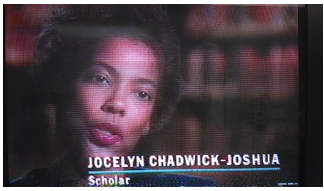
One of the questions for your notes on viewing Born to Trouble is: "Tell me about one of the experts in the film that impressed you.  Who was it?  Why did you remember what they said?"  I've posted these "screenshots" from the video copy we saw in class last week so you may keep up with who is who.  Think of this as your "scorecard."

Rachael Pantone and her mother, Kathy Monteiro
Shelley Fisher Fishkin
David Bradley
James Miller
Jocelyn Chadwick-Joshua or "Sister Joshua"

Thursday, September 5, 2013

Adv. Comp.: Setting Up Pulse for News Reading

Pulse.me is pretty cool, and I have had many students over the last two years tell me that they really enjoyed it's graphic interface.  Pulse.me is also very forward-leaning with respect to current web technologies.  Here's a paragraph, written by Seth Rosenblatt at Cnet and posted about a year ago:

Pulse's Web app at Pulse.me is built entirely from HTML5, CSS3, and JavaScript, and indicates that the future-Web technologies are rapidly approaching a state where they can easily re-create native app experiences in the browser. The site is accessible from most major browsers on traditional PCs and mobile devices. With the touch-focused Windows 8 and its associated touch screen hardware coming at the end of October, the site has been specifically designed to be touch-friendly.


Also, I found that Pulse's core mission is agreeable to the modern writing class and very much agreeable to me personally.
In class we discussed the way to set-up your pulse.me account and feed, and I encouraged you to download the app corresponding to your smart phone and/or tablet.

Once logged in, you are to include "News" as a category and add five feeds that I require: The Daily Beast, Salon, Slate, The New Yorker, and The Atlantic.  When you click on your news category the feeds should look like this:


After setting up "News" then you should add seven of these "required" feed-categories:


Your final list should look something like this:


Now, finally for this first step, add two articles for future reading from all eight categories or at least 16 total (for now at least).

Tuesday, May 21, 2013

eng. 3: some extra credit avail.

Students

The annual Summer Reading book fair is coming up on Thurs. of this week.  (That's the day-after-tomorrow!)  We are going to be dropping by the LRC during class.  As you remember from past years, the bookfair is a good time for the purchase of that essential summer reading.

Every Maine South student MUST read at least two books this summer -- one from the "choice" list and one that is assigned.  As you know, your required book is based on the English course you have in the first semester of senior year.  In order to learn which book you must read, follow this link to a .pdf copy of a spreadsheet with your first and second semester English course listed.

If you want a bit of extra credit related to summer reading THIS school year, I have a small task for you.

1. visit the Maine South home page and print a copy of the "choice" list and a copy of the "required" list ...

2. after consulting the .pdf referenced above, determine which book you will read this summer ... this is of course non-binding but it would be good to get an idea of what you might/will read ...

3. staple the lists together and highlight  the two books you will read ... put your name on these lists and bring them to the beginning of class on Thurs.

It's that simple!

~Dr. Jones